The BIOWISE consortium has completed a major milestone within Work Package 2 with the publication of the Global report about industry and academia consultation sessions, which validates the thematic areas that will underpin the future BIOWISE elective course.
The validation process was based on six national focus groups organised in Slovenia, Spain, Portugal, Poland, and Italy, involving a total of 40 stakeholders from industry, academia, research organisations, clusters, associations, and innovation support organisations. The consultations focused on identifying the knowledge and competences most relevant for supporting the transition towards bio-based industries, particularly within the wood, furniture, and textile sectors.
A stakeholder-driven approach
The BIOWISE methodology combined structured focus group discussions with individual prioritisation questionnaires, enabling the collection of both qualitative and quantitative evidence. Stakeholders assessed seven predefined thematic areas covering scientific, technological, regulatory, and sustainability-related dimensions of bio-based systems.
The analysis confirmed that all thematic areas are relevant, while also highlighting the need for a structured curriculum that differentiates between foundational, transversal, and specialised topics.
The BIOWISE Thematic Areas Framework
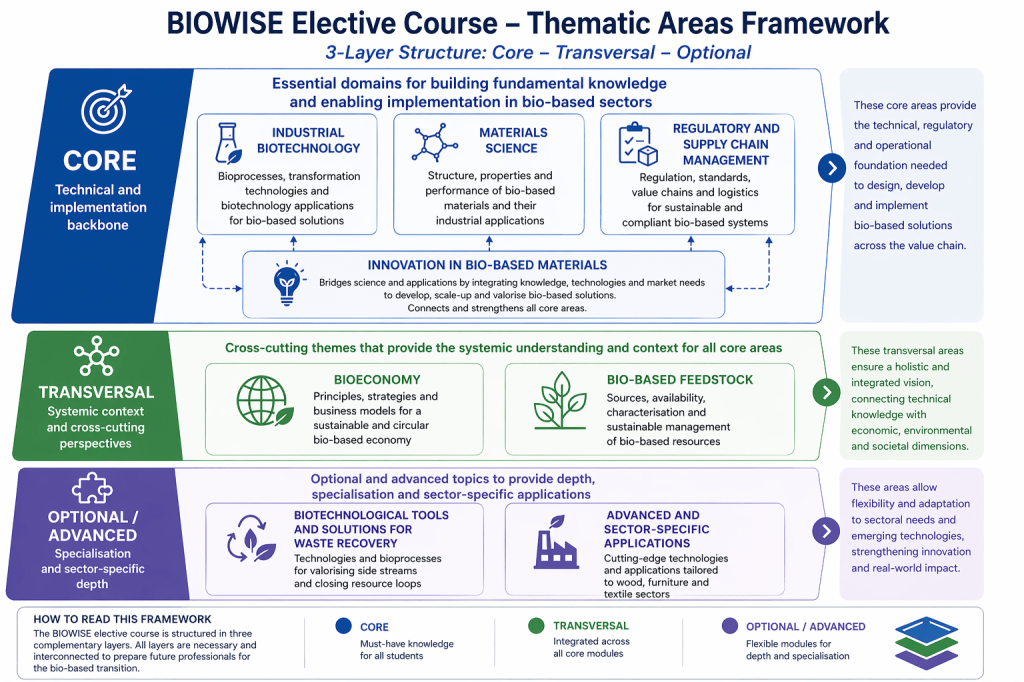
As a result of the validation process, the consortium developed the BIOWISE Thematic Areas Framework (Figure 1), which organises the thematic areas into three complementary levels.
Core thematic areas
- Materials science
- Industrial biotechnology
- Regulatory and supply chain management
- Innovation in bio-based materials
These areas form the technical and implementation backbone of the future course and provide students with the knowledge needed to develop and deploy bio-based solutions.
Transversal thematic areas
- Bioeconomy
- Bio-based feedstock
These themes provide the systemic perspective required to understand sustainability, circularity, resource management, and value chain dynamics.
Optional and sector-specific thematic areas
- Advanced and sector-specific applications
- Biotechnological tools and solutions for waste recovery
These topics allow the curriculum to be adapted to specific industrial contexts and emerging technological developments.
Preparing the next generation of bio-based professionals
A key outcome of the consultation process is the recognition that future professionals need more than technical expertise. Stakeholders consistently highlighted the importance of interdisciplinary competences, practical problem-solving skills, value chain understanding, and the ability to translate innovation into real industrial applications.
The validated framework will now serve as the basis for the next activities of Work Package 2, including the definition of learning outcomes, competence profiles, teaching modules, and training materials for the BIOWISE elective course.